Free template · In Lean: 5 Whys worksheet
5 Whys Template: find the cause you can change
What it is and when to use it
A 5 Whys worksheet for office teams: one why-chain from a written problem to a cause you can change, with evidence for each answer, and a page for two branches.
A worksheet for running the 5 Whys on paper or in a shared file. Page 1 takes one problem, written as facts, through a chain of whys to a cause the team can change, with the evidence for every answer beside it. Page 2 is for problems with two causes at once: it splits the chain into two branches and asks whether together they explain everything you counted. Use it after you have looked at the work, before anyone proposes a fix.
Download
Blank, ready to print or fill in on screen. No account, no email.
- PDF, A4 99 KB
- PDF, US Letter 99 KB
- Markdown (.md) 4 KB
- Word (.docx) 6 KB
- Excel (.xlsx) 8 KB
Free to use, change and share, also at work, under CC BY 4.0. Keep the line “Template by KaizenProof” on copies you share.
Preview
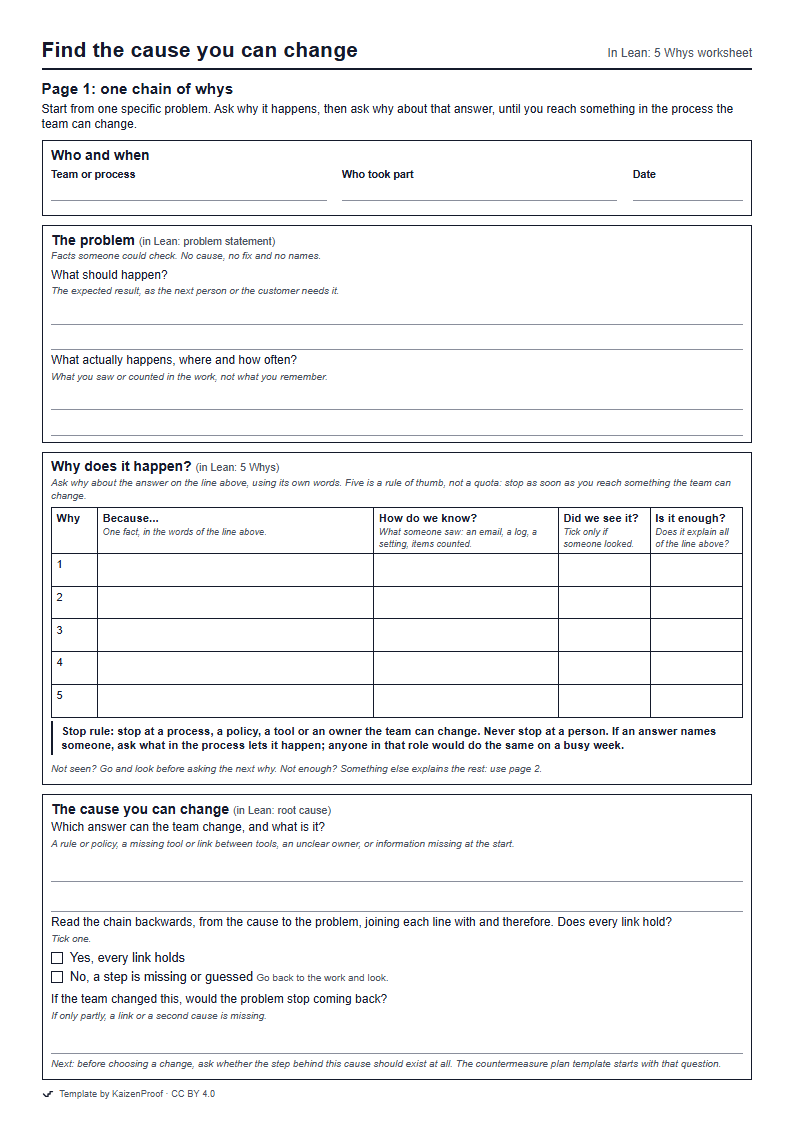
How to fill it in
- Who and when Name the team or process and who took part. The people who do the work belong in the room.
- The problem Write what should happen and what actually happens, with where and how often. Use facts someone could check. Leave out the cause, the fix and any names: those come later.
- Why does it happen? Ask why the problem happens and write the answer as one fact. In the next column, write how you know. Tick the two boxes only when someone has seen it and it explains the whole line above. Then ask why about that answer, in its own words. Stop when you reach something the team can change, even if that is the third line.
- The cause you can change Copy the answer the team can change. Read the chain backwards with and therefore between each line; if a link sounds wrong, go back and look. Ask whether changing it would stop the problem coming back. If only partly, turn to page 2.
- Where the chain splits When a why has two answers that are both backed by evidence, note the problem and the point where the chain splits.
- Branch A Follow the first answer down its own chain, with evidence for each line, to a cause the team can change.
- Branch B Do the same for the second answer. Keep the two chains apart.
- Do the branches explain the whole problem? Count how many of the items you looked at each branch explains. If some are left over, there is another branch. Decide which branch to work on first and where the other is recorded.
An example, filled in
Illustrative example, not a real company.
An operations team at a mid-sized services company looks at expense claims that are sent back to employees before they can be paid.
Who and when
- Team or process
- Expense claims, finance operations
- Who took part
- Two finance assistants, a team lead, one employee who submits claims
- Date
- 2026-10-12
The problem
- What should happen?
- An expense claim is paid in the first weekly payment run after it is submitted.
- What actually happens, where and how often?
- Of the last thirty claims, eleven were sent back at least once for a missing or unreadable receipt. Those eleven were paid two or three runs later.
Why does it happen?
- Table
Why Because... How do we know? Did we see it? Is it enough? 1 The finance check finds the receipt missing or unreadable after the manager has signed the claim off. The return reason recorded in the expense tool for all eleven claims. yes yes 2 The claim form lets a line be submitted with no receipt attached. Tried it in the test account: the form submits with no file. yes 3 The receipt field was made optional when company card lines were added, and nobody decided which lines still need one. The settings history of the expense tool, and the finance lead confirmed no rule was written. yes 4 5
The cause you can change
- Which answer can the team change, and what is it?
- Nobody owns the rule for which expense lines need a receipt, so the form asks for none.
- Read the chain backwards, from the cause to the problem, joining each line with and therefore. Does every link hold?
- Ticked: Yes, every link holds
- If the team changed this, would the problem stop coming back?
- For missing receipts, yes. Three of the eleven were unreadable photos, which this chain does not explain: a second branch.
Common mistakes
- Ending at a person. An answer such as the clerk made a mistake describes what happened, not why the process let it happen. Ask what makes that mistake easy or likely.
- Building on a guess. An answer nobody has seen in the work, such as the system is probably slow at month end, leads to the wrong fix. Look first, then ask the next why.
- Writing two more whys to reach five. A chain that reaches a cause the team can change in three steps is finished.
Learn the method
Related guides
Try it on your own work
Pick one task that wastes your team's time every week and describe it in a sentence. KaizenProof names the waste, asks why until you reach the cause, asks whether the step should exist, and writes the change. No account is needed to start.