Free template · In Lean: countermeasure plan
Countermeasure Plan Template: plan a change and check it held
What it is and when to use it
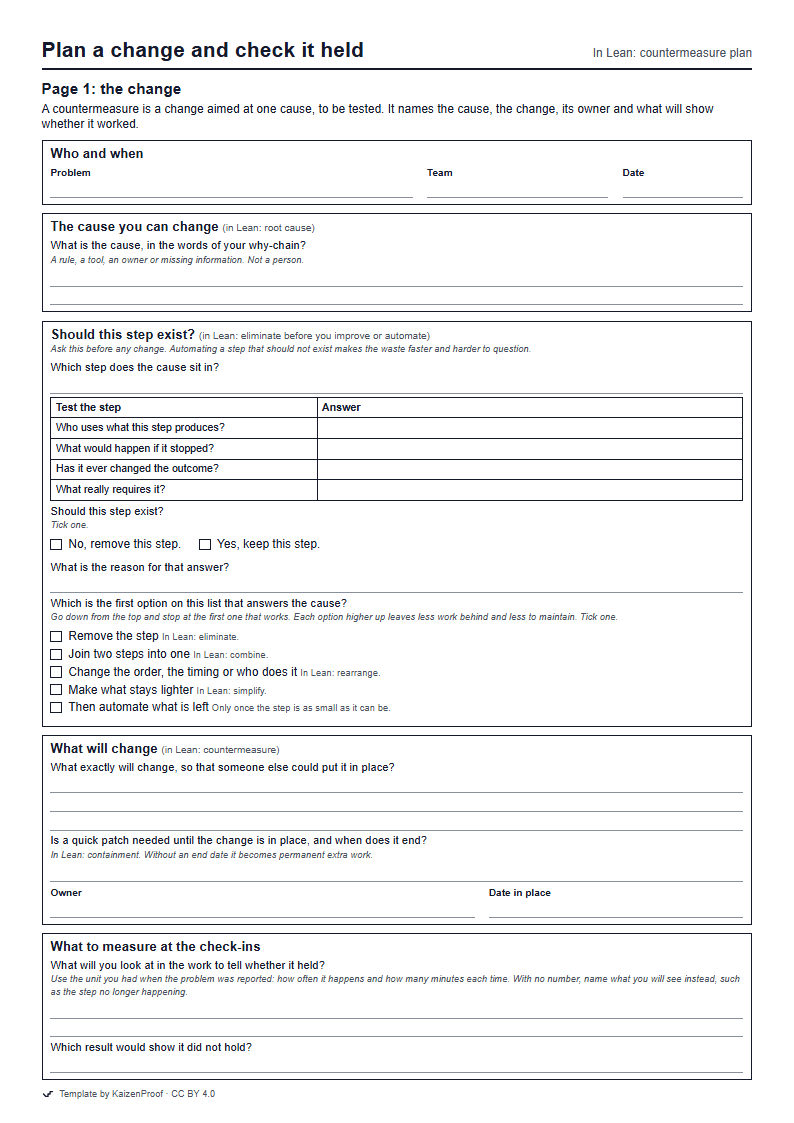
A countermeasure plan template: the cause, should this step exist?, the change, its owner and what to measure, then a day 7, 14 and 30 check-in log.
The plan for one countermeasure, on paper: the cause it answers, whether the step should exist at all, the first option from remove to automate that answers the cause, the change itself with an owner and a date, and what to measure. Page 2 is the check-in log for day 7, 14 and 30, with the time before the change and the time saved after it in two separate boxes, never added together.
Download
Blank, ready to print or fill in on screen. No account, no email.
- PDF, A4 102 KB
- PDF, US Letter 102 KB
- Markdown (.md) 4 KB
- Word (.docx) 6 KB
Free to use, change and share, also at work, under CC BY 4.0. Keep the line “Template by KaizenProof” on copies you share.
Preview
How to fill it in
- Who and when Name the problem in a few words, the team and the date.
- The cause you can change Copy the cause from your why-chain, in its own words. If you cannot name the cause a change answers, the change is a guess.
- Should this step exist? Name the step the cause sits in and answer the four questions about it. Tick whether it should exist and give the reason. Then go down the list from Remove the step and tick the first option that answers the cause.
- What will change Write the change concretely enough that someone else could put it in place. If the problem has to be held back today, write the quick patch and its end date. Name the owner and the date it will be in place.
- What to measure at the check-ins Write what you will look at in the work and which result would show it did not hold. Use the numbers you had when the problem was reported; if there were none, name something you can see instead.
- Time before the change Copy how often the problem happened and how many minutes it took each time, as reported, and the minutes a week. If nobody gave a number, write no figure.
- Check-in log At about a week, two weeks and a month, look at the work and record held, partly or reverted, what you saw, and minutes a week saved only if someone gives that figure at the check-in.
- Time saved after the change From the latest check-in answered, write the minutes a week saved and tick where the figure comes from. Reverted, or no figure given, means no figure.
- After day 30 After day 30, decide what happens next.
An example, filled in
Illustrative example, not a real company.
A sales operations analyst plans a change to how new customer contracts reach billing.
Who and when
- Problem
- Billing details chased after contract signature
- Team
- Sales operations
- Date
- 2026-10-07
The cause you can change
- What is the cause, in the words of your why-chain?
- The contract template has no billing contact field, so billing details are collected only after signature.
Should this step exist?
- Which step does the cause sit in?
- Sales operations chasing sales for billing details after each contract is signed.
- Table
Test the step Answer Who uses what this step produces? Billing uses the details to send the first invoice. What would happen if it stopped? Invoices would go to the wrong contact or not at all. Has it ever changed the outcome? Yes, it is how billing gets the contact today. What really requires it? Billing needs a contact; nothing requires collecting it after signature. - Should this step exist?
- Ticked: Yes, keep this step.
- What is the reason for that answer?
- Billing needs the details, but the chasing exists only because they come too late.
- Which is the first option on this list that answers the cause?
- Ticked: Change the order, the timing or who does it
What will change
- What exactly will change, so that someone else could put it in place?
- Add a required billing contact section to the contract template, so the details are collected before signature.
- Is a quick patch needed until the change is in place, and when does it end?
- Until the new template is live, sales operations asks for billing details when the contract is sent. Ends when the template is in use.
- Owner
- Sales operations lead
- Date in place
- 2026-10-14
What to measure at the check-ins
- What will you look at in the work to tell whether it held?
- For each contract signed, whether sales operations had to chase billing details. At the report it happened about 6 times a week, 15 minutes each.
- Which result would show it did not hold?
- Any contract signed on the new template that still needs a chase.
Time before the change
- How often
- 6 times a week
- Minutes each time
- 15
- Minutes a week
- 90
Check-in log
- Table
When Date answered Did it hold? What did you see in the work? Minutes a week saved, if given Day 7 2026-10-21 held No chases for the five contracts signed. Day 14 2026-10-28 held No chases. Day 30 2026-11-13 partly Contracts on the old template, still in negotiation, needed chasing. 60
Time saved after the change
- Minutes a week
- 60
- From the check-in at day
- 30
- Where does this figure come from?
- Ticked: Given at the check-in
After day 30
- What happens next?
- Ticked: Partly: aim the next small change at the part that did not hold
Common mistakes
- Starting at automation. Ask whether the step should exist and go down the list from the top; a faster version of a pointless step is still pointless.
- One impact number. Adding the time before the change to the time saved after it counts the same friction twice.
- Filling gaps. Writing 0, a guess or half the first estimate where nobody gave a figure. Write no figure.
Learn the method
Related guides
Try it on your own work
Pick one task that wastes your team's time every week and describe it in a sentence. KaizenProof names the waste, asks why until you reach the cause, asks whether the step should exist, and writes the change. No account is needed to start.