Free template · In Lean: PDCA worksheet
PDCA Template: plan, try, check, then decide
What it is and when to use it
A PDCA template for office teams: plan a change with a prediction a check could prove wrong, try it small, check at day 7, 14 and 30, then decide.
A worksheet for running one change as an experiment: plan it with a prediction a check could prove wrong, try it on a small scale, check at about a week, two weeks and a month, then decide whether to adopt, adjust or abandon it. Before the change itself, it asks whether the step should exist at all. Use it once you have a cause you can change.
Download
Blank, ready to print or fill in on screen. No account, no email.
- PDF, A4 93 KB
- PDF, US Letter 93 KB
- Markdown (.md) 3 KB
- Word (.docx) 6 KB
Free to use, change and share, also at work, under CC BY 4.0. Keep the line “Template by KaizenProof” on copies you share.
Preview
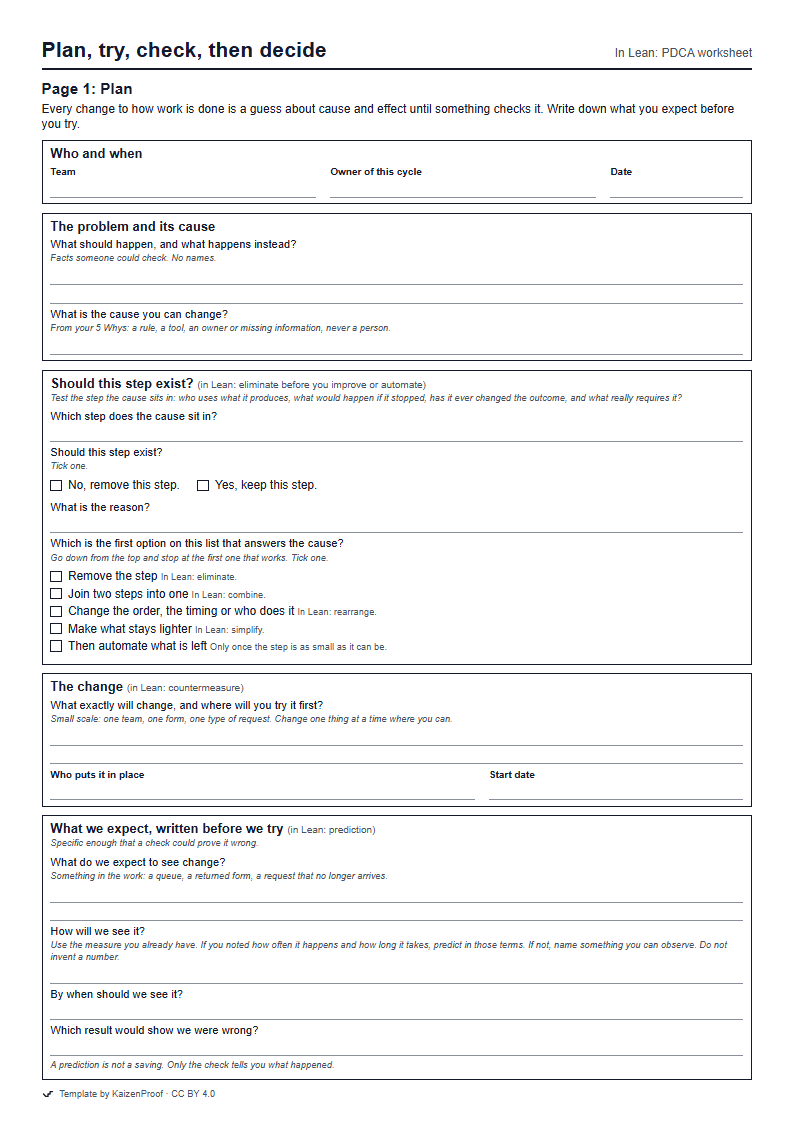
How to fill it in
- Who and when Name the team and the person who owns this cycle.
- The problem and its cause Restate the problem as facts and copy the cause from your 5 Whys.
- Should this step exist? Name the step the cause sits in and test it against its value. Tick your answer and the reason. Then go down the list from Remove the step and stop at the first option that answers the cause.
- The change Write the change concretely, where you will try it first, who puts it in place and when it starts.
- What we expect, written before we try Before you start, write what you expect to see, how you will see it, by when, and which result would show you were wrong. Use the measure you already have; if you have no number, predict something you can observe.
- Do: try it Afterwards, write what you actually did and anything that went differently from the plan.
- Check: what happened? At each check, look at the work and write held, partly or reverted with what you saw. Then compare the result with the prediction on page 1.
- Act: decide Decide: adopt it as the normal way, adjust it and run another cycle, or go back to the cause. Note what you learned and what the next cycle is.
An example, filled in
Illustrative example, not a real company.
An IT service desk tries a change to how new starters get system access.
Who and when
- Team
- IT service desk
- Owner of this cycle
- Service desk lead
- Date
- 2026-10-06
The problem and its cause
- What should happen, and what happens instead?
- New starters should have system access on their first morning. Of the last ten, four waited a day or more.
- What is the cause you can change?
- Access is requested only when the starter arrives, because nothing tells IT a start date has been confirmed.
Should this step exist?
- Which step does the cause sit in?
- The starter's manager raising an access ticket on the first day.
- Should this step exist?
- Ticked: Yes, keep this step.
- What is the reason?
- Access still has to be requested and agreed by someone; the timing is the problem.
- Which is the first option on this list that answers the cause?
- Ticked: Change the order, the timing or who does it
The change
- What exactly will change, and where will you try it first?
- HR raises the access request when the start date is confirmed, using the existing ticket form. Tried first for the sales team.
- Who puts it in place
- HR coordinator
- Start date
- 2026-10-13
What we expect, written before we try
- What do we expect to see change?
- Every sales starter has working access on the first morning.
- How will we see it?
- The service desk notes, for each sales starter, whether access worked at nine on day one.
- By when should we see it?
- Within a month, covering the next four sales starters.
- Which result would show we were wrong?
- Any sales starter without access on the first morning.
Do: try it
- What did we actually do, when, and where?
- HR raised requests for three sales starters from 13 October. One start date was confirmed by the agency, not HR.
- What did not go as planned?
- HR did not hear about the agency starter's date in time.
Check: what happened?
- Table
When Date Did it hold? What did we see in the work? Day 7 2026-10-20 held One starter, access ready. Day 14 2026-10-27 held One more starter, access ready. Day 30 2026-11-12 partly The agency starter waited a day: HR never saw the date. - Did what we predicted happen?
- Partly. The prediction failed for the agency starter, so the cause has a second branch.
Act: decide
- What do we do now?
- Ticked: Adjust: change it and run another cycle
- What did we learn, and what is the next cycle?
- Agency start dates reach the hiring manager, not HR. Next cycle: the hiring manager raises the request when the agency confirms the date.
Common mistakes
- Writing the prediction afterwards. By then it describes what happened, not what you expected.
- A prediction that cannot fail. Things will improve is true of any result; name the result that would show you were wrong.
- Skipping the check. Moving on to the next idea without looking means nobody learns whether the last one worked.
Learn the method
Related guides
Try it on your own work
Pick one task that wastes your team's time every week and describe it in a sentence. KaizenProof names the waste, asks why until you reach the cause, asks whether the step should exist, and writes the change. No account is needed to start.